Note
Go to the end to download the full example code.
Multiscale Direction Disks
This example shows how to use the UDCT curvelets transform to visualize multiscale preferrential directions in an image. Inspired by Kymatio’s Scattering disks.
# sphinx_gallery_thumbnail_number = 2

from __future__ import annotations

import matplotlib.pyplot as plt
import numpy as np

from curvelets.numpy import UDCT
from curvelets.plot import create_inset_axes_grid, overlay_arrows, overlay_disk
from curvelets.utils import apply_along_wedges, normal_vector_field
Input Data
aspect = dz / dx
figsize_aspect = aspect * nz / nx
opts_space = {
    "extent": (x[0], x[-1], z[-1], z[0]),
    "cmap": "gray",
    "interpolation": "lanczos",
    "aspect": aspect,
}
vmax = 0.5 * np.max(np.abs(data))
fig, ax = plt.subplots(figsize=(8, figsize_aspect * 8))
ax.imshow(data.T, vmin=-vmax, vmax=vmax, **opts_space)
ax.set(xlabel="Position [km]", ylabel="Depth [km]", title="Data")
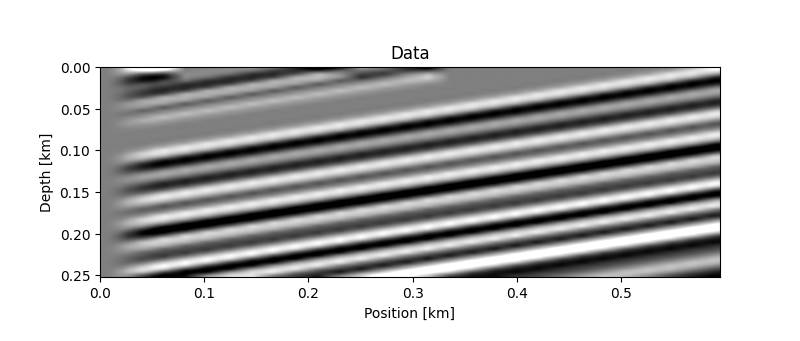
[Text(0.5, 34.64692810457516, 'Position [km]'), Text(53.972222222222214, 0.5, 'Depth [km]'), Text(0.5, 1.0, 'Data')]
UDCT
Cop = UDCT(data.shape, num_scales=3, wedges_per_direction=3)
d_c = Cop.forward(data)
Normal Directions via FFT2D
Compute average normal vector. This vector indicates the direction normal to the structures of the image
Scattering Disk via UDCT
Now we compute the average energy of each curvelet “wedge”. We will plot this on a multiscale disk to show the distribution of energies along different directions of the various scales in the data.
fig, ax = plt.subplots(figsize=(12, figsize_aspect * 8))
ax.imshow(data.T, vmin=-vmax, vmax=vmax, **opts_space)
overlay_arrows(kvecs, ax, arrowprops={"edgecolor": "w", "facecolor": "k"})
ax_o = create_inset_axes_grid(ax, width=0.4, kwargs_inset_axes={"projection": "polar"})
overlay_disk(energy_c, ax=ax_o, vmin=0, cmap="turbo", linecolor="w", linewidth=5)
ax.set(xlabel="Position [km]", ylabel="Depth [km]", title="Data")
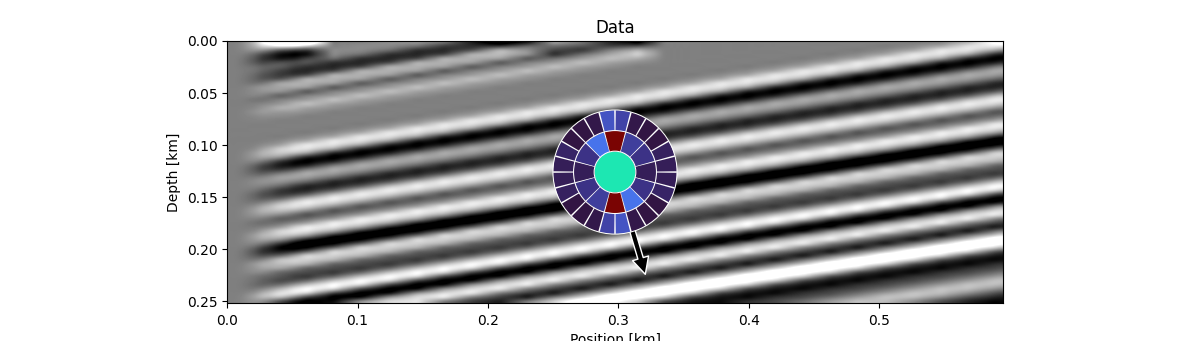
[Text(0.5, 8.26888888888889, 'Position [km]'), Text(181.12037037037038, 0.5, 'Depth [km]'), Text(0.5, 1.0, 'Data')]
Total running time of the script: (0 minutes 0.330 seconds)